
Eight telling signs, two signs of maturity
Eight flagship companies changed course between April and October 2026, from Accenture charging excess AI use back to teams to Amazon scrapping a token leaderboard.
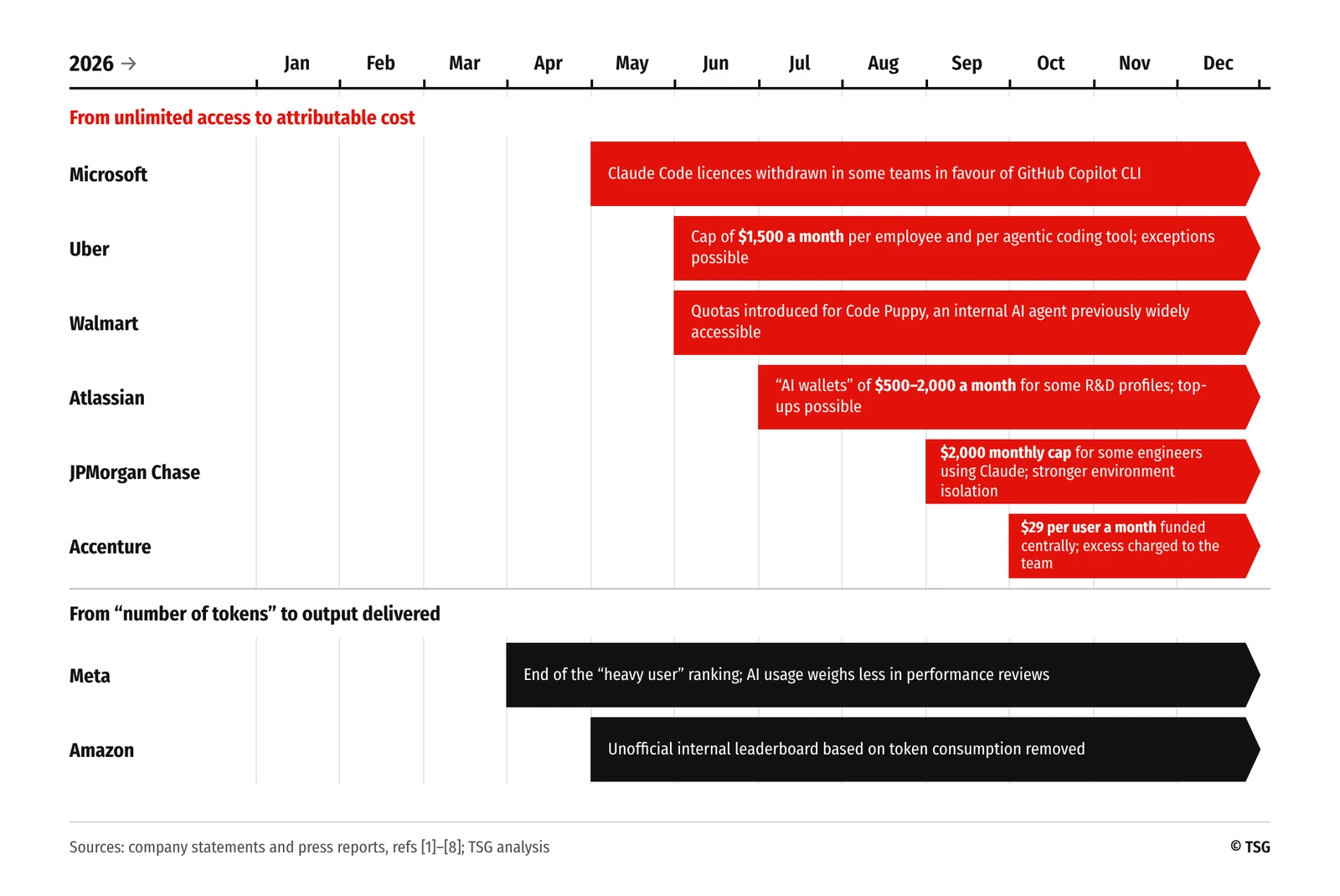
From unlimited access to attributable cost
Accenture, Uber, Atlassian, JPMorgan and Walmart show the same need: knowing who consumes what, for what purpose and from which budget. Agents capable of chaining many operations make spending vary with usage intensity. A quota does not measure value; it creates a constraint that forces value to be made explicit.
From “number of tokens” to output delivered
Meta and Amazon illustrate a second problem: once the volume of prompts or tokens becomes a performance signal, there is a risk of rewarding consumption rather than work accomplished. Adoption metrics remain useful for confirming a rollout, but are insufficient for judging its economic contribution.
The shift in management framework
As AI use matures, the centre of gravity shifts on every dimension: from management focused on spreading usage — activated users, volumes generated, broad experimentation — towards management focused on measurable results, full costs and explicit decisions to stop or scale up.
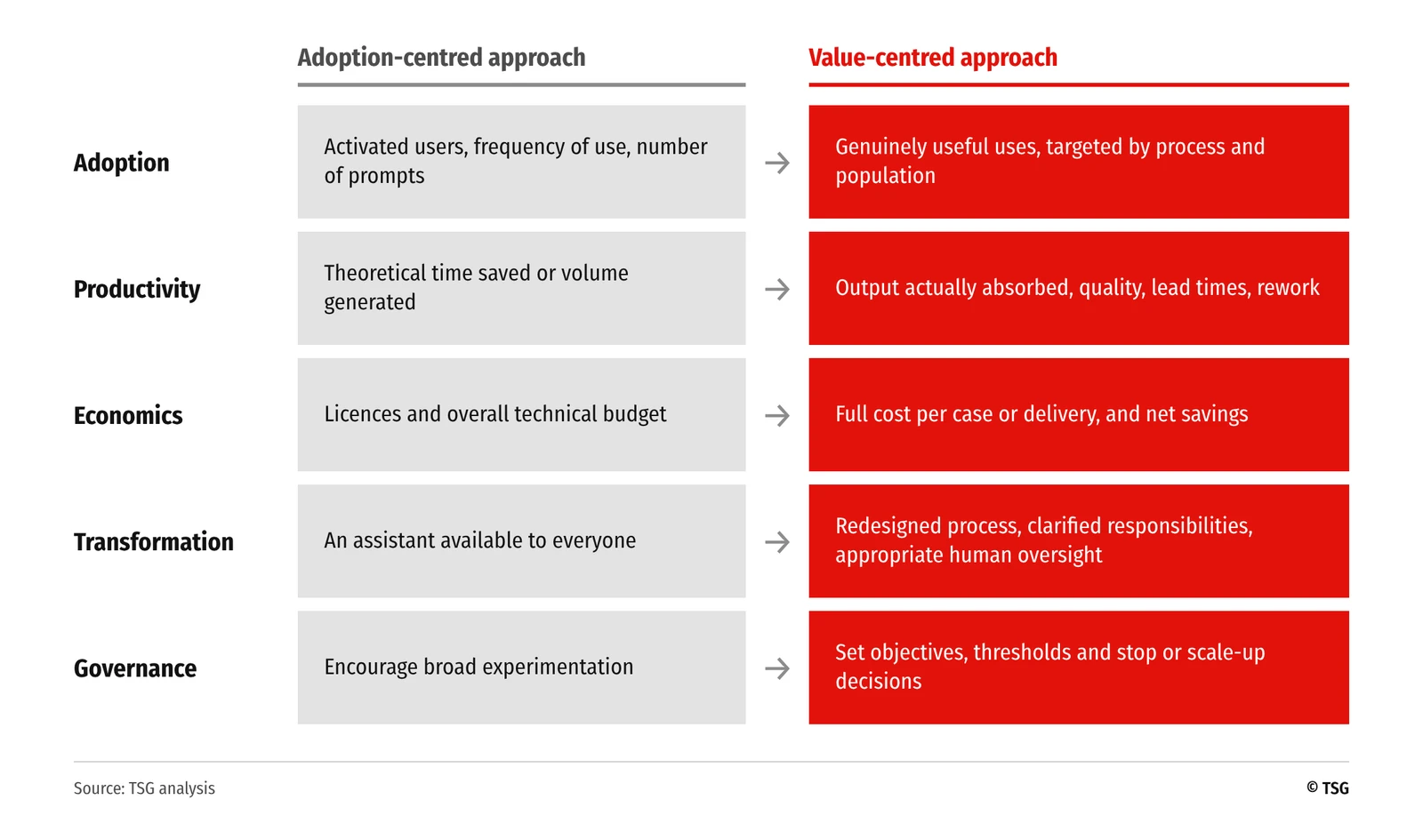
How can value be demonstrated?
Management can be organised on three levels that must not be confused.
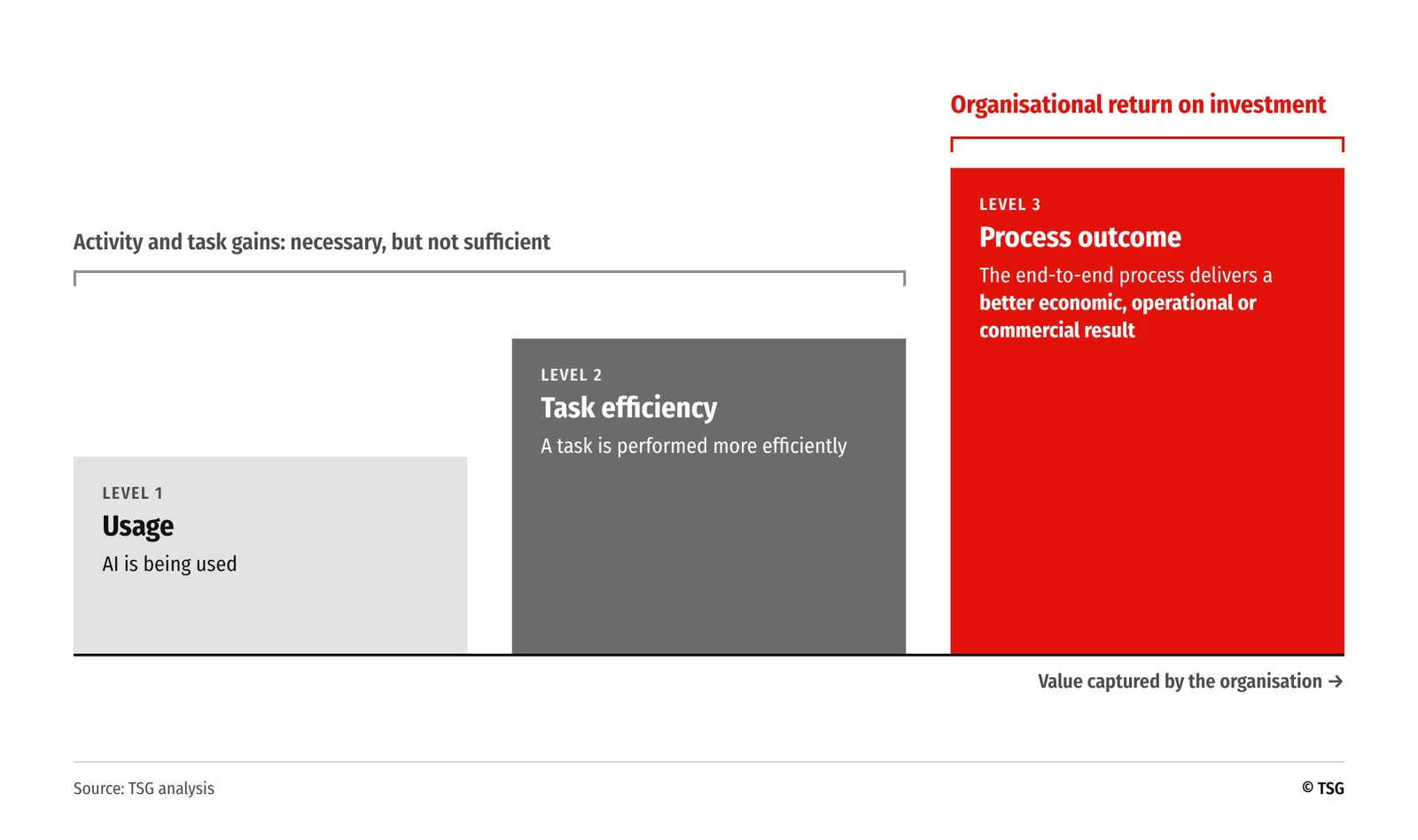
- Which result changes? Number of cases closed, end-to-end lead time, quality delivered and rework rate, compared with a baseline.
- At what full cost? Cost of models, licences, integration, supervision, corrections and ongoing operational maintenance.
- Where does the value materialise? Freed-up capacity actually redeployed, confirmed avoided costs, additional revenue or risk reduction.
- What decision follows? Extend, adjust or suspend use according to thresholds set before the pilot.
Is this an isolated phenomenon?
An Elastic study published in July 2026 reports that one third of the Australian companies surveyed exceeded their AI budget, while around 32% slowed down or suspended some deployments. According to Elastic, only 8% directly measure the revenue or savings attributable to AI. The study covers Australia and should not be extrapolated without caution. [9] In February 2026, an IBM Apptio survey of 1,510 technology leaders found that 90% struggled to measure the ROI of technology investments. This finding covers IT as a whole, not just AI. [10]
FAQ
How should AI spending be allocated: central funding, showback or chargeback?
Central funding speeds up adoption but hides marginal cost. Showback makes consumption visible without billing it; chargeback ties it to a P&L. A common pattern, as at Accenture, combines a centrally funded baseline allowance with chargeback above the threshold, so that heavy use has to be justified by the activity that benefits from it.
Which unit of work should anchor a cost-per-output metric?
The unit must be meaningful to the business and stable over time: a ticket resolved, a pull request merged and deployed, a contract reviewed, a claim settled. Avoid intermediate units such as lines of code or documents generated, which reward volume. The test: would a process owner track this unit even without AI?
How can a credible baseline be built when AI is already widely used?
Measure the process before rollout where possible; otherwise use staggered deployments, comparable control teams or historical series adjusted for volume and complexity. Self-reported time savings should be treated as a signal, not as evidence. Without a counterfactual, any improvement may simply reflect seasonality, staffing or process changes.
Which hidden costs are most often left out of the business case?
Human review and correction time, rework caused by errors, the integration and maintenance of agents, security and compliance controls, and the technical debt created by generated code that is poorly understood. These costs grow with usage intensity and often appear in other teams’ budgets, which makes the apparent ROI look better than it is.
How should stop or scale-up decisions be governed?
Set thresholds before the pilot: minimum gain on the target unit of work, maximum full cost, acceptable quality level. Review the portfolio of use cases at fixed intervals, as with any investment, and give a named business owner the authority to extend, adjust or stop. A use case without an owner or a threshold should not move beyond the pilot stage.
Conclusion
The question is no longer simply “how many employees use AI?” It becomes: “which unit of work or business result is improved, at what full cost and with what level of quality?” Caps are a tool for budgetary discipline; managing value additionally requires measuring results.
Sources
- [1] 404 Media · 15 Oct. 2026 — Accenture’s Claude funding policy (opens in a new tab)
- [2] Bloomberg News · 2 June 2026 — Usage caps on coding tools at Uber (opens in a new tab)
- [3] The Guardian · 30 July 2026 — Atlassian’s AI wallets (opens in a new tab)
- [4] Business Insider · Sept. 2026 — Claude: cap and security at JPMorgan (opens in a new tab)
- [5] Bloomberg News · 2 June 2026 — Rationing of an internal agent at Walmart (opens in a new tab)
- [6] The Verge · May 2026 — Reallocation of Claude Code licences at Microsoft (opens in a new tab)
- [7] WIRED · 2 Sept. 2026 — Meta: AI usage and employee reviews (opens in a new tab)
- [8] Business Insider · May 2026 — Internal consumption leaderboard at Amazon (opens in a new tab)
- [9] Elastic · 6 July 2026 — Australian study on AI budgets and results (opens in a new tab)
- [10] IBM Apptio · 20 Feb. 2026 — Survey on measuring technology ROI (opens in a new tab)